PortFast and BPDU guard
STP initialization states
To appreciate what PortFast fixes, start with what a port normally goes through when it’s enabled. In STP and PVST+, every port transitions through these stages, exchanging BPDUs every two seconds along the way to make sure it isn’t about to introduce a loop:
- Blocking: up to 20 seconds (the max age). The port stays blocked.
- Listening: 15 seconds (forward delay). The port processes received BPDUs and watches for new topology information; a better BPDU sends it back to blocking. No MAC learning, no forwarding.
- Learning: up to 15 seconds (forward delay). The port now populates the MAC address table, but still doesn’t forward.
- Forwarding: the port forwards frames, while still monitoring for topology changes that could send it back to blocking.
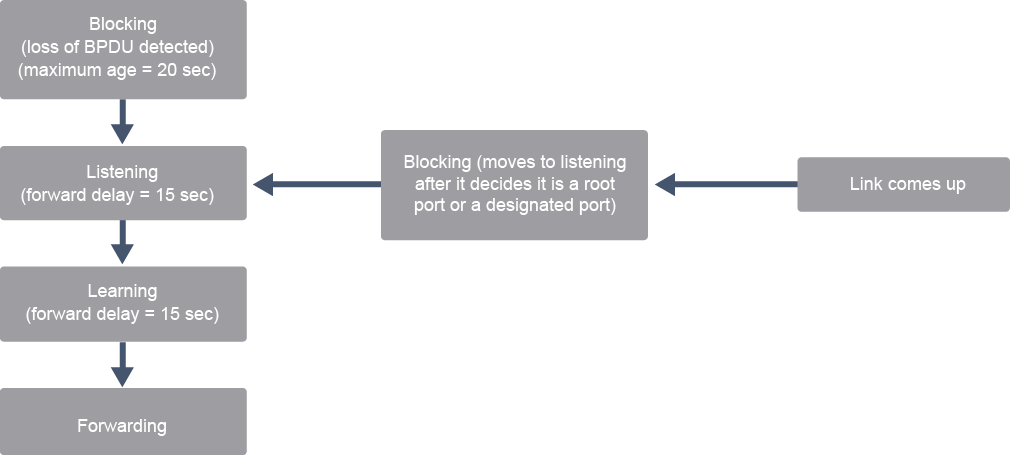
For a switch-to-switch link, that whole cycle is necessary. For an access port with a PC, laptop, server, or printer on it, it’s 30+ seconds of dead air that can cause real problems, like DHCP timeouts. There’s no loop possible on a port connected directly to a host, so the full STP machinery is wasted there.
PortFast
PortFast is a Cisco enhancement that lets an access port skip the listening and learning states entirely: blocking straight to forwarding, immediately. Use it on access ports connected to a single workstation or server, or on a trunk toward a router in a router-on-a-stick setup.
A side benefit: a PortFast port doesn’t generate a TCN when its state changes. Rebooting a host on a normal port would trigger a topology change notification and MAC table flushing across the network; with PortFast, a host rebooting has no impact on STP at all.
With rapid spanning tree the convergence pain mostly goes away on its own, but organizations still commonly enable PortFast at the access layer anyway.
The problem PortFast creates
In a valid PortFast configuration, no BPDUs should ever arrive on the port, because hosts and Layer 3 devices don’t generate them. A BPDU showing up means somebody connected a switch.
The classic scenario: a user wants more bandwidth, sees two network jacks in their office, and plugs a personal switch into both. If PortFast is enabled on both access ports, the loop forms instantly, with no listening or learning phase to catch it, and the network grinds to a halt.
Worse, there’s no authentication in spanning tree. A switch brought in from home joins the Layer 2 domain and participates in the election like any other. If it has a low enough bridge ID, it becomes the root bridge.
BPDU guard
The rule: if a BPDU is received on the port, shut it down. BPDU guard transitions a PortFast-enabled port into errdisable state on BPDU reception and logs a level 2 syslog message:
2000 May 12 15:13:32 %SPANTREE-2-RX_PORTFAST:Received BPDU on PortFast enable port. Disabling 2/1
2000 May 12 15:13:32 %PAGP-5-PORTFROMSTP:Port 2/1 left bridge port 2/1
That covers both the accidental cabling error and the rogue switch from home. Devices behind PortFast + BPDU guard ports can’t influence the STP topology, which enforces the STP domain diameter and keeps the active topology predictable.
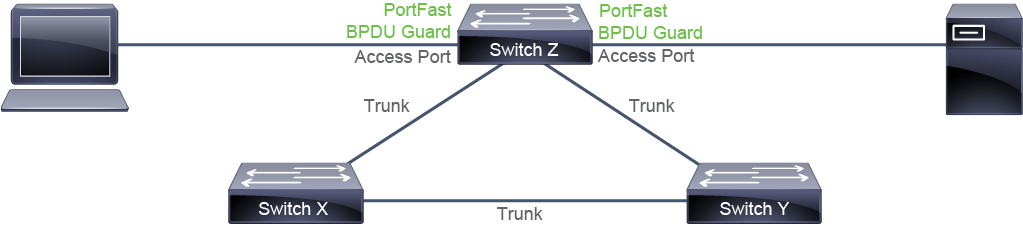
Deployment rule: these are access layer features. If you’re going to use PortFast, always pair it with BPDU guard. BPDU guard alone on access ports is worth having regardless.
Other stability mechanisms exist beyond CCNA scope, like root guard, which stops any rogue switch from becoming root even on ports where BPDUs are expected.