Issues in redundant topologies
Without a protocol monitoring link forwarding states, a redundant switch topology is vulnerable to three conditions:
- Continuous frame duplication: switches flood broadcast, multicast, and unknown unicast frames out every port except the one they arrived on, the copies duplicate, and they travel endlessly around the loop in all directions. For broadcasts this is a broadcast storm.
- Multiple frame transmission: destination hosts receive multiple copies of the same unicast frame. Many protocols expect exactly one copy per transmission, so duplicates can cause unrecoverable errors in the receiving application.
- MAC database instability: different ports keep receiving copies of the same frame, so the switch keeps rewriting where it thinks the source lives. Forwarding suffers while the switch burns resources coping with the churn.
All three come from one unicast frame in the right (wrong) topology.
The walkthrough
Four switches in a square, no loop prevention anywhere. Host A (192.168.3.1) hangs off switch W, host B (192.168.3.2) off switch Z, and every MAC address table starts empty:
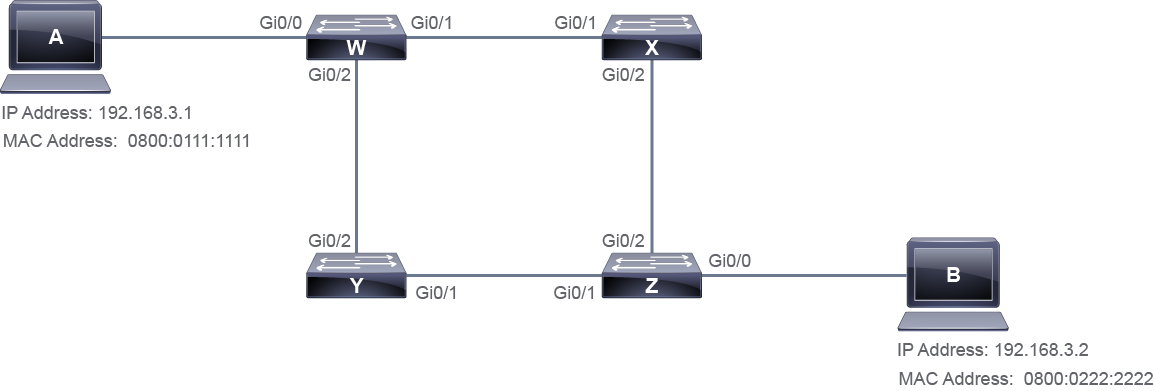
Host A sends a frame to host B. No switch has learned B’s address yet, so it’s unknown unicast the whole way:
- Switch W receives the frame, learns host A’s MAC on Gi0/0, and floods it to switches X and Y.
- X and Y each learn host A behind the port facing W. Both forward the frame on to switch Z.
- Z receives two copies of the same frame: one from X, one from Y.
- Say the copy from X arrives first. Z learns host A on the port facing X, doesn’t know where B is, and floods: to host B, and to switch Y.
- The copy from Y arrives. Z rewrites its table (host A is now “behind Y”), then forwards to host B again and to switch X.
Host B has now received the frame twice, and it keeps coming. X and Y receive the copies Z forwarded, rewrite their tables to point at Z, and forward again. Every switch in the square is now cycling the same frame and relearning host A’s location on every pass. That’s multiple frame transmission and MAC database instability from a single ordinary unicast.
If it had been a broadcast
Same mechanics, worse outcome. An ARP request, say, gets flooded by every switch on every pass with nothing to stop it, in both directions around the square. The copies eventually consume all available bandwidth and block other traffic on the segments: the broadcast storm. Unlike the unicast case, there’s no moment where a switch learns the destination and stops flooding, because a broadcast never has one.