Redundant topologies and Layer 2 loops
Why redundancy
An enterprise network should never rely on one device or one link as a single point of failure; losing it can take out communication inside the enterprise and beyond. So redundant topologies add extra switches and redundant links between them: if an uplink fails, there’s always another one to use.
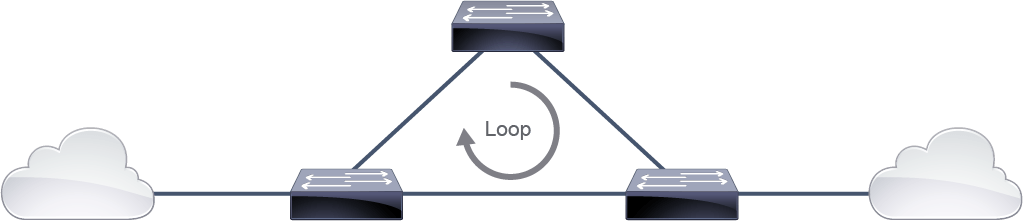
Connecting two switches to the same network segments keeps things running when one segment has problems. But the moment redundant physical links exist, a physical loop exists, and spanning a single VLAN across those connected switches makes it a Layer 2 loop too.
No TTL at Layer 2
Layer 3 already has this solved: the IPv4 header carries a TTL, so even a routing loop eventually kills the packet after enough hops. Ethernet has no equivalent. There is no field in a frame that counts hops and no mechanism for a switch to recognize a frame it has already forwarded, so looping frames circulate forever.
How it starts: somebody sends a broadcast. A switch’s nature is to flood it out every port except the one it came in on, the neighboring switches do the same, and in a very short amount of time the frames are chasing each other around the triangle:
The blocked port
The fix is to deliberately block a port on one segment so the loop can’t form. Blocked means all traffic: broadcast, unicast, and multicast. Think of it as a street under construction, barrier up, nobody drives down it. The only time traffic fails over to the blocked port is when one of the active links dies.
That’s Spanning Tree Protocol in essence: keep the physical redundancy, block just enough ports to make the logical topology loop-free, and unblock when a failure demands it. Which is also why you never disable STP in a Layer 2 environment.
Where STP came from
The original spanning tree was developed by Radia Perlman at DEC and standardized as IEEE 802.1D in 1990. It’s still around, but its big limitation is convergence delay after a topology change, so Rapid STP (RSTP) is what’s recommended now. RSTP is backward-compatible with classic STP, but to get the full benefit every switch in the topology has to run the rapid version; mixing them falls back to slow behavior on those links.
Cisco also has its own optimized variant, PVST+ (Per VLAN Spanning Tree Plus), which runs a separate spanning tree instance per VLAN. More on the flavors, STP/RSTP operation, and the stability mechanisms in the next notes.