Network topologies and traffic characteristics
The four topology shapes, then how the traffic riding them behaves:
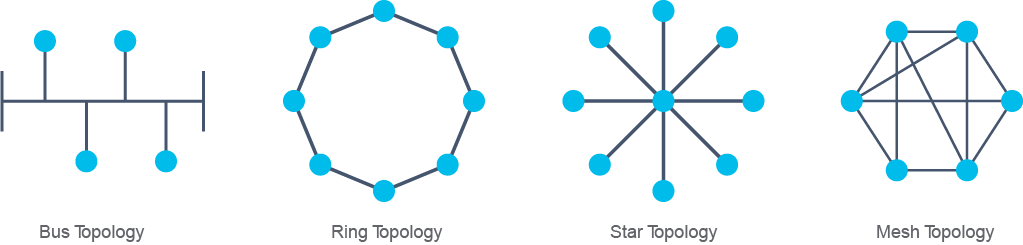
The topologies
Bus
Every workstation connects to a common transmission medium: a single cable called the backbone or bus. All devices share the same medium, so only one device can transmit at a time, and a break in the backbone can bring down the whole segment.
Ring
Computers and other network devices are cabled in succession, and the last device connects back to the first to form a circle. Each device connects to exactly two neighbors and has no direct connection to any others; traffic travels around the ring to reach non-adjacent devices.
Star
The most common physical topology: a central device connects to all other network devices via point-to-point links. Also called hub-and-spoke.
There are no direct physical connections between spoke devices; all traffic passes through the central device.
An extended star replaces one or more spoke devices with a device that has its own spokes: multiple star topologies whose central devices are connected to each other.
Mesh
A device can be connected to more than one other device, so multiple paths exist between nodes. Redundant links increase reliability and let the network self-heal around a failed link.
A full mesh connects every device to every other device: the most redundant and the most expensive. A partial mesh gives only some devices redundant links, and sometimes shows up in WANs.
Topologies in practice
A physical star with a switch as the central device is by far the most common LAN implementation today. When a switch interconnects the devices, both the physical and logical topologies are stars.
Mesh is not typically used within a LAN. Partial mesh shows up in WANs, and full mesh is reserved for cases where the cost is justified by the redundancy.
Traffic characteristics
- Data: smooth or bursty, bandwidth benign or greedy, insensitive to both drops and delay.
- Voice: smooth and benign, but sensitive to drops and delay.
- Video: bursty and greedy, and sensitive to drops and delay.
One-way requirements:
- Voice: latency under 150 ms, loss under 1%, 30-128 kbps.
- Video: latency under 150 ms, loss under 0.1-1%, anywhere from 384 kbps to 20+ Mbps.
Quality of Service (QoS)
QoS is a way to identify different types of applications so that, when there’s a traffic jam on the network, certain types of traffic get expedited ahead of others.
Batch applications
FTP, TFTP, inventory updates. No direct human interaction; bandwidth is important but not critical.
Interactive applications
An inventory inquiry. Human-to-machine interaction; response time and bandwidth are important but not critical.
Real-time applications
VoIP and video. Human-to-human interaction, and end-to-end latency is critical.